The Babies We Carry Still
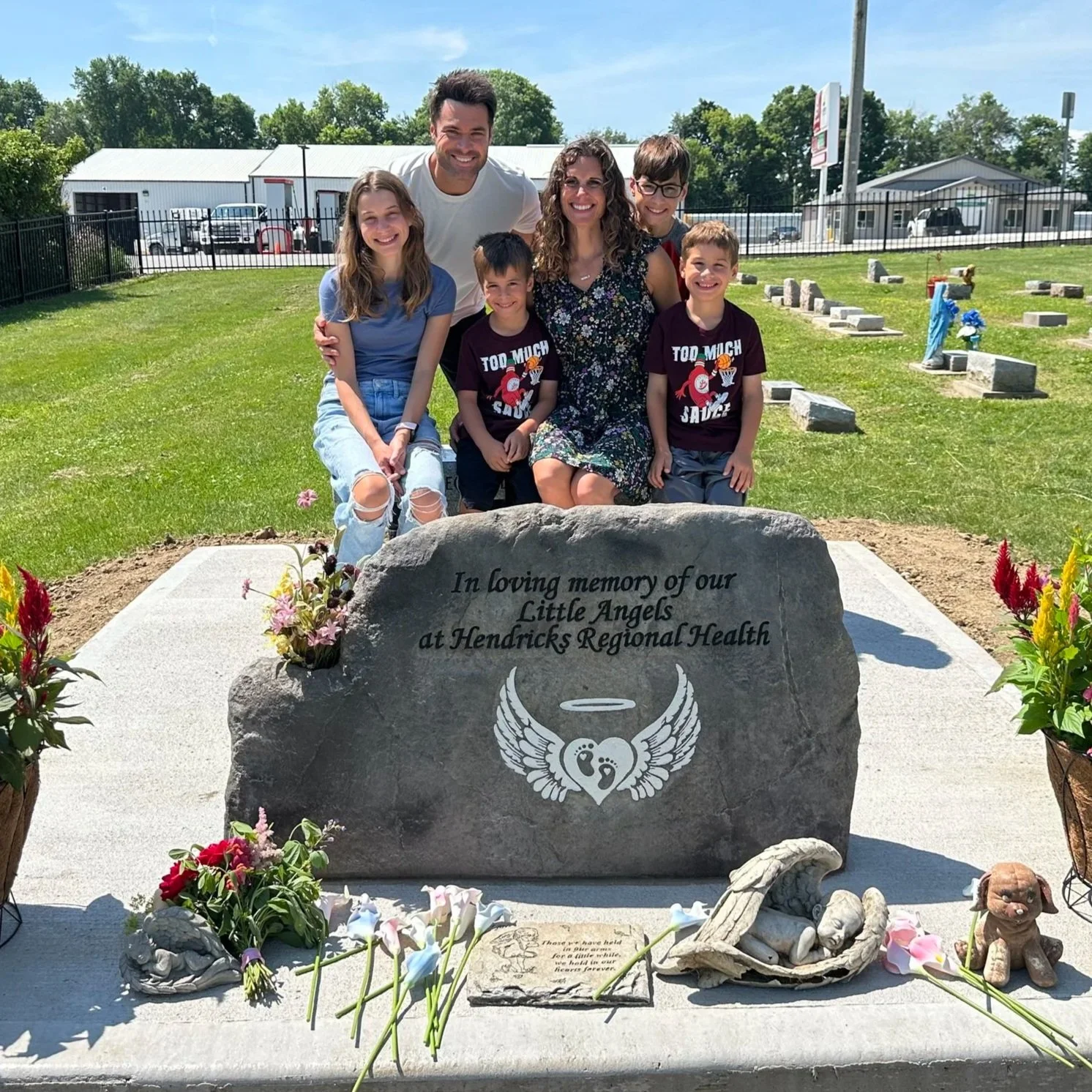
I had the honor of being the guest speaker at a hospital's graveside memorial service for families who have experienced child loss. The hospital is dear to me, because it is where I delivered Seth and Roi. It is not easy to speak to a group of hurting families, but I have found the tension of joy and grief through it—being able to use my own story of death to point others to the hope in Jesus Christ.
The following is my speech. If you have not experienced the loss of a child, I encourage you not to pass over, because my message is also for the loved ones of grieving families.
Wednesday, August 28, 2019
I crawl into bed, grab the covers, and bury myself underneath. The dam of emotion needs to break open. So I let it. I claw at the pillow and sob. The grief has overtaken me after experiencing several triggers of death and loss over the last few days. I finally allow myself to fully feel it rather than fighting through it each day. I said goodnight to the kids only minutes before. My husband, Brett, should be on his way home soon from his softball game.
I am alone, and I find myself in this position of helplessness, brokenness, and suffocating pain, almost to paralysis, where all I can do is sob because my mind cannot process much else. It’s all so familiar now, after fifteen months of grieving. It’s almost becoming…a friend? Maybe I’m crazy. But I’m finding myself more and more not afraid of the grief and pain. It’s a paradox: finding comfort in grief. I sense when the dam needs to be released. When the waves are too much. I yearn for solitude. I need to find refuge in the tears and cries of pain.
Therefore, I bury myself deep under. Hidden and safe. Where I meet my new friend, Grief, who I used to view as foe. This friendship has deepened, and I now anticipate the other side of this wave. I will get through this. I will get back up and keep going. I’m gonna be OK. I’m being made stronger. I only have to endure this pain a little while longer. Some waves last longer than others. So until then…
I sob with Grief, and cry out, “Lord, help me!” over and over again. It is made definite to me that Grief is my friend, not my foe, because each time she meets me here, she spurs me to my Lord. I now long for these moments because I am surrounded by the presence of God. The covers over me are not my blankets. They are the shelter of His wings. I am hidden and safe because He is my refuge. I hide in the darkness of pain and suffering because the dark shadow of His wing is my protection. When I can’t breathe, He breathes for me.
And He doesn’t leave me here. Every time, He saves all my tears in a bottle and hears my cry of help. Jesus is always present in pain and suffering. He will rescue me over and over when I cry out to Him, and there is truly nowhere else to run for comfort.
After some time, my tears have slowed to a stop. The deep wave is receding. My hope is made secure once again in the assurance that at the end of this dark, deep, hard place, I will find: Peace. Strength. Security. Breath. Comfort.
Comfort is found with Grief. Until next time, friend.
That is an excerpt from my book, Living Hope—a book I wrote as I grieved the loss of my two sons, Seth and Roi, each at 13-weeks gestation. I delivered them at this hospital and was a recipient of its compassionate bereavement services. However, I wrote this over a year after I lost Seth, and four months after I lost Roi; therefore, what you have just heard is the continuous, raw, intense emotions I experienced even after fifteen months of grieving.
I should have been over it by then, right? Or, at the very least, I should have accepted it and been further along in my healing? NO, there is no timetable for grief. It’s not linear either. You will be up, then down. At peace one day, and then angry the next. You will finally feel relief from the suffocation, only to find yourself in bed sobbing again. It’s all so painful and confusing, so we try to avoid it, medicate it, or numb it. We come to believe that grief is the enemy.
The dictionary defines grief as “an intense emotional suffering caused by loss, misfortune, injury or evil of any kind.” Let’s see, the death of a child is— loss? Yes. Misfortune? Yes. Injury? For some, yes. Evil? Yes.
But grief—this intense emotional suffering—is not the enemy; death is the enemy. Death and suffering were never God's plan. That was never His will. From the very beginning, my sons weren't supposed to die. Your sons and daughters weren’t supposed to be taken from you so soon.
But here we sit, and we acknowledge that death is here and real. However, in order to truly mend and heal from the emotional suffering, we must learn to grieve, and walk through the deep, dark valley of the shadow of death, not around it, nor in denial or avoidance. But it is through the valley that we will find life and peace waiting on the other side.
So then, how do we grieve? What do we do with the intense amount of emotions? How do we get up and take the next step? The next breath?
Especially since child loss trauma is real, and like most trauma, it’s a silent suffering. The world goes on, and we have to somehow go on living our lives, while carrying the burden of loss for all earthly time. There is a disconnect for other people because it’s not seen. In fact, some mask the pain as if they have moved on, yet inside it is eating away at their very soul.
You never know who has lost a baby in a room full of women. According to miscarriage statistics, one in four pregnancies ends in miscarriage. That’s too many babies and too many women, especially for those who have conceived more than once.
The trauma pain runs deep. Bandages cannot be used over the wound. Self-medicating or false comforts cannot keep the pain away because the death of a baby affects the mother mentally, emotionally, and physically.
I have been writing my next book—a practical book on how loved ones can come alongside and show comfort and compassion to a grieving mother who has lost a baby. As I researched the effects that child loss has on the mother, I read that several studies have found that “child loss has a profound and multifaceted impact on the health of the mother, increasing the risk of both psychiatric and physical morbidity.”
There is an increased risk of hospitalization, depression, anxiety, and post-traumatic stress. The first year after child loss is the most detrimental, but the intensity of these effects continue for at least five years. Even after five years, the suffocating waves may even out and the mother can regain health and stability, but her baby remains with her.
In the book, The Nurture Revolution, author Greer Kirshenbaum says,
“The babies we have lost remain part of us forever. The experience changes our brains, changes our bodies, and the babies we lose leave behind their cells. Furthermore, the cells from the babies we lose can transfer from our babies through the umbilical cord into the future babies we carry, so the babies we birth also contain cells from babies we may have lost.”
We have suffered the intense pain of saying goodbye and never getting to watch our baby grow up, yet our baby’s cells stay inside us. It isn’t just a figure of speech when we say, “I will always have my baby in my heart.” No, this is literal, and it changes us mentally, emotionally, and physically for the rest of our lives.
Furthermore, a mother carries not only the DNA of her baby, but also the weight of shame. In the midst of my grief, I was flooded immediately with doubts and questions, most of them turned inward: What did I do wrong? What is wrong with me? What is wrong with my body? Did I do something that possibly killed my child?
Author and counselor, Edward Welch in his book, Shame Interrupted, says:
“Shame is the deep sense that you are unacceptable because of something you did, something done to you, or something associated with you. You feel exposed and humiliated.”
God chose to intricately create a woman’s body to carry human life at its earliest formation. Childbearing has been a cultural standard since the beginning of time. Barren women throughout history have been considered outcasts or deemed worthless. Infertility carries its own stigma—the woman’s value is diminished if she cannot bear a child.
Even in a culture that is trying so desperately to change gender definitions and stereotypes, a mother carrying the weight of her child’s death cannot refute the shame it brings. Shame told me that conceiving a child yet being unable to protect that child from harm and death meant—I am not enough. I am a failure. I am not acceptable.
This shame runs as deep through our veins as the very cells our babies left behind. Shame also says that if I cannot be a mother, I am somehow less than human. The death of the tiny human that came from us erodes our own humanness. And for every life ended, another layer of our soul is cut off.
If you start to feel this shame like I did, you are not alone. This is a normal, human response because of what has happened to us. However, there is a warning. Edward Welch continues to say,
“Assume that shame always accumulates lies.”
If we give in to shame, we cannot detach ourselves from the loss of our babies; the loss overpowers our soul and it becomes our identity. We will continue to live silently tormented, believing those shameful lies: I am not enough. I am a failure. I am not acceptable.
Isolation, silence, denial, avoiding the grief, masking or numbing the pain are all common responses to this shame that entwines and suffocates. Vulnerability is the enemy of shame, which is why many do not open up about the loss. For centuries, it has been taboo to talk about miscarriages, stillborns, and infant loss. Women have resorted to learning to live with the shame yet never fully heal. I have personally witnessed this— after speaking to rooms full of women about my miscarriages, women much older than me have broken down because for decades they never talked about the babies they had lost.
You may be asking, “Why are you telling us this, Christina? This is not hopeful! This is even more depressing!” Because I wish I had known these things earlier, and I don’t want you to be that mother who, decades from now, never allowed herself to grieve, gave into the shame and lies, and prolonged her healing through the dark valley. And for the loved ones of grieving mothers—I want you to understand the lasting effects the baby will always have, so that you can show her compassion, grace, and patience.
But there’s more—there is hope. There is always light in the darkness. Yet to heal our hearts, we must first understand and prepare for how dark it can become. We have to dig deep and expose the cracks in our souls—those lies and shame hidden there. When we bring the light of Truth into that darkness, shining it upon those lies and that shame, healing can begin.
The Truth and only hope for this dehumanization is to detach from shame and attach ourselves to the One who became shame for us. Jesus reached out and touched the outcasts. The ashamed reached out to touch Him. Lepers, Gentiles, prostitutes, women, even barren women— the lowest in the cultural caste—were fully human in His eyes. Every person has value, no matter what they have done or what has happened to them. That includes you. That includes your baby.
A mother who believes she is less than human needs to encounter the touch of God, who became Human for her. Shame flees when you find your identity through His love and compassion. Your grief, the death of your precious baby, what other people may think or say to you, or how society portrays you…these do not define you. You are seen. You are acceptable.
You are enough. When shame is removed, you won’t be any less—you will become even more.
Your grief over the death of your baby is what actually makes you human. Without sadness, anger, despair, and lament for any amount of time, you would be indifferent and without love. Love makes us human. Today is a day to speak our babies’ names. We remember. We honor. We grieve what should be here. We love.
This is a significant step in the journey of grief and healing. Yet where do you go from here? How do you receive this touch of God in the midst of your grief, pain, and shame?
At the beginning, you eavesdropped on one of the many intense feelings of suffering I experienced. That is how I learned to detach myself from the shame and pain and attach myself to Jesus, who became shame for me. I encountered His acceptance, His love, His compassion, His patience as I lamented to Him. Rather than numbing the pain, I surrendered to it and cast it onto God Himself.
Exodus 20:21 says, “The people stood far off, while Moses drew near to the thick darkness where God was.”
I also found God in the thick darkness.
Diane Langberg says in her book, Suffering and the Heart of God,
“Lament [is when] people pour out their complaints to God and ask him to act on their behalf. David says in Psalm 13:1, 'How long, O Lord? Will You forget me forever?' Lament encourages people to be honest with God and to speak the truth about their feelings and doubts and questions. They do not try to solve the problem; they simply let God know honestly what they are feeling and thinking.”
She continues, “Jesus said that part of what he came to do was heal the brokenhearted and comfort those who mourn. The Bible also says that he has borne our griefs and carried our sorrows. That means we will never encounter any grief, our own or another’s, that he has not carried. He is our Great Comforter. He is the expert in sorrow and longs for us to bring him our troubled hearts as we live in this troubled world. He himself bore the sorrows of the soul. He himself bore the crushing of the body. He says to us, ‘Come. Come to me.’ He will hear your laments, your questions, your doubts, and your sorrow.”
We can come to Jesus because He Himself suffered sorrow and death. The death of the Son of God was the only way to conquer all of death and our eternal separation from Him. When we attach ourselves—our identity, our weaknesses, and our griefs—to Jesus, who was called the Man of Sorrows, we can believe the promise in Isaiah 25:8,
“He will destroy death forever. The Lord God will wipe away the tears from every face and remove His people’s disgrace (shame) from the whole earth, for the Lord has spoken.”
Today, as you begin or continue this journey of lament and wait for the day when death will be destroyed, the Lord will wipe away all our tears and remove all our shame, let me encourage you: you will start to discover the tension between grief and joy.
You’ll laugh uncontrollably at the silliness of a child, only to find yourself sobbing soon afterward. You’ll force yourself out of bed—when it’s the last thing you want to do—to take a walk. You’ll feel the breeze, notice the beauty of a flower or a sunset, and release a deep sigh of peace.
You’ll eat dinner outside with your husband and four children, on the eighth anniversary of the death of your first baby and seven years after the loss of your second baby. You’ll hear the wind chime in their memory, tears streaming down your face onto your plate. Yet as you listen to the music carried by the wind, you’ll realize that much of the grief has been replaced by hope—the hope that one day you will hear their laughter.
It is the grace of God, the light in the thick darkness, that we experience this tension as we heal. It’s not either-or; it’s both-and. The joy does not eliminate the grief, but it will overwhelm the grief. Joy makes the grief less bitter. And the grief makes the joy—oh, so much sweeter.
Hebrews 12:2 tells us: “We do this by keeping our eyes on Jesus, the champion who initiates and perfects our faith. Because of the joy awaiting him, he endured the cross, disregarding its shame. Now He is seated at the place of honor beside God’s throne.”
The joy Jesus knew was coming when He defeated death gave Him the hope and encouragement to endure grief and sorrow. Likewise, my prayer is that you will lament your pain to Jesus, let Him carry your shame, and allow His presence to surround you.
Then you will experience what I did. The tears will slow to a stop. The deep wave will recede. Your hope will become secure in the assurance that at the end of this dark, deep, hard place, you will find: Light. Peace. Strength. Healing. Joy.
And you will be able to say…
“Comfort is found with Grief. Until next time, friend.”